Month: January 2023

  • How to Save Money When You Make Nothing at Work Part 1

    How to Save Money When You Make Nothing at Work Part 1

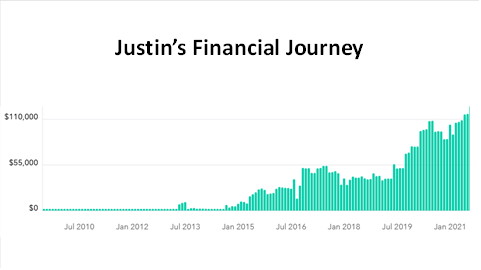
    Net Worth Over Time

    This chart is a fairly accurate view of my net worth over time, give or take a few thousand dollars. This is taken from my mint.com account(a personal finance tracking website). You may guess from the fact that I have data from the time I was ~19 years old on mint.com that I was a bit of a financial freak even at that age. You can see that my wife and I steadily saved money even during our college years(2009-2020). This is in spite of only making $26,555 collectively per year on average from 2012 to 2020. For perspective, the average wage in the United States for a single fast food worker is $25,848. This is about $13 an hour for a full time employee. Somehow we managed to save approximately 40% of our Gross income during that time.

    How did we do it?

    Eating Out Less

    Alright, so prepare yourself for a new time consuming hobby. If you haven’t already guessed, it is cooking. I have been married to my wife for long enough at this point to realize that she loves cooking. I’m really fortunate that this is the case. But when I lived by myself, I never ate a single meal that I didn’t cook myself. Why? Well to be honest I wasn’t primarily thinking of the health benefits, though I did cook incredibly healthy meals. The real reason was that I didn’t feel I could afford to spend money on eating out. Why would I pay someone to wash my dishes, when I was getting paid ~minimum wage myself? I might as well do the extra hour or so of work each day to prepare all my meals (the meals themselves were not elaborate).

    Which brings up another point. I’m not a picky eater. I don’t know what exactly sets our flavor palette, but I’ve noticed that I tend to be satisfied with my meal almost no matter what. It has to be pretty terrible for me not to enjoy it. Give me a bowl of rice and a bit of protein and I’m happy. This served me very well when I was cooking for myself, because I never truly developed a love of cooking, in part because I didn’t have quality cooking tools like pots, knives, or good stove. I was willing to compromise on taste because it wasn’t important to me, but if that is something that is important to you, I’m sure that you will be able to find a core set of recipes that will satisfy you and won’t let you down.

    Give Less Gifts

    It is hard for me to separate what is actually my preferences, vs preferences I developed because I’ve been a relatively low wage earner for so long. I just don’t love giving gifts. If that is your jam, and you love giving gifts, find ways to make your gifts more about the heart and the intent, and less about the dollar value of the gift that you give. You don’t need to buy your girlfriend a new laptop or camera in order to show them that you love them. They would probably be content with flowers and chocolates (my wife likes just flowers). Also, not to be a scrooge, but the American consumerist mindset around certain holidays and celebrations just doesn’t sit right with me. I recognize I might be on the fringes of society here, but people need to keep in mind that we live in such a wealthy place that extravagant gift giving has been normalized. I’ve seen people spend easily hundreds of dollars on their children. Right now I am getting my kids socks for Christmas, and helping their grandparents purchase a Tricycle for them. That is pretty much it for their Christmas gifts. It isn’t that I don’t love my children, it is just that I choose to let them know that in different ways that don’t require my house to be filled with crappy plastic toys that break after 6 days of usage.

    Don’t be afraid to say NO to other people’s hobbies

    So I admit, this one has always been a little more difficult for me to stick to. When someone invites you out to join them on some adventure that they like to take, it is hard to say no. But don’t ever compromise your goals just so you can spend more time with someone, no matter how cool they are. Some people’s hobbies are really expensive. My local ski mountain is $100+ for a single day lift ticket, and that wouldn’t even include a ski rental. I also have friends that spend thousands of dollars on their hobbies, and make a $120 ski pass look cheap.

    Here is probably the most awkward of all the things that I’m going to tell you I do. I legitimately have said no to social invites if they include going to a restaurant. I know, I know, I’m a anti-social grouch, but hear me out. There is a group of people where I work that go out every Friday to get a meal together, during the course of which I’d estimate they spend about $25 each time, that is $1200+ a year in food that I’m not spending. Now perhaps I do eat $2 worth of food each Friday instead of going to the restaurant, but that still means I’m saving around $1100 a year on food. If I invest just this year’s savings, it will be worth around over $10,000 by the time I retire. I’d rather have the $10,000 than the extra time with my coworkers. Obviously this equation doesn’t work in every situation, and if I thought I needed to spend that money in order to advance my career for instance, I would totally do it.

    The point is that you can’t let peer pressure force you to spend money that you otherwise wouldn’t spend.

    Develop Cheap Hobbies

    Cheap hobbies are things like hiking, camping, natural resource collection (I’m thinking of picking fruit, hunting, gardening, etc). To be clear though, your hobbies could be vastly different then mine are, the only requirement is that you aren’t spending more than about $5-10 a week on this hobby. (I’m estimating I spent something like that on gas money to do my hobbies.)

    It isn’t only what your hobby is, sometimes it is how you do your hobby. Some people manage to spend thousands of dollars on something I can do for $100-200. Do they get 10x enjoyment out of it? Rhetorical question, the answer is no. They don’t. Also, if you find that you can’t participate in a hobby cheaply, maybe you should consider dropping the hobby.

    Frequency of Epic Adventures

    Don’t get me wrong. I think big expenditures to experience something that you will look back on for the rest of your life can be a great idea. A once in a lifetime expense may be worth it, especially if you can amortize the cost over your entire life. For example, a 3,000 dollar trip to Europe might be worth it, if you consider that it is only $1 a week when spread out over your entire life. Keep in mind that just because you have the money doesn’t mean you should use it for this. If $5-10 a week is your goal for your hobbies, just bear in mind that these large trips are coming out of the same financial bucket as your weekly hobbies are.

    Develop Negative Cost Hobbies

    Low cost or no cost hobbies are great, but they can’t compare to hobbies that make you money. Some of my hobbies are: buying and reselling anything, but particularly tools, trailers, and construction equipment. I’ve averaged somewhere near $2300 per year for the last 10 years. I’ve also kept up a hobby of doing construction work, particularly remodeling houses…I can’t take all the credit for this, but an older gentleman who I got to know during my time in Alaska saw potential in me, and asked me to renovate a house for him. We split the profit when it sold, and I made just a little more money on that transaction than I did on my full time job that year.

    Part time work

    If you are a full time student, you should be able to fit in some type of part time work in order to “start thy purse to fattening” This will do two things for you: first, it will provide you with additional funds. Second, it will increase your ability to be efficient with your time. If you don’t have time to waste, you will be less likely to waste your time. The goal is to fall into bed tired at the end of every day, not spend 1-2 hours every night catching up on the latest Netflix. If you aren’t doing school full time in the summers you are going to want to pick up a job. I decided to pursue construction full time in the summers since it was what I already knew how to do. Use whatever skill set you have to make money. If you have no skills you can always be a waiter, busboy, coffee shop barista, valet, janitor or window washer. Don’t let your lack of a resume stop you from being able to find ways to make money.

    Dumpster Diving

    Alright, this one is polarizing. I feel like about half the population hears me talk about this one and is like “I’ve always wanted to do that” and the other half of the population is like “you did WHAT?”.

    Occasionally I run into someone else who has done this, and it always warms my heart to know I’m not the only one who hates to see “valuable” things go to waste. I put valuable in parenthesis because I’ve definitely brought home some things I shouldn’t have from time to time. Here is the thing about dumpster diving. If you are below a certain income threshold, say about $40,000 a year, I think it makes a lot of sense IF (a big if) you can find a dumpster that consistently tosses things that you can use or resell. For me, the only places that I’ve consistently found success was at Home Depot and Harbor Freight. Keep in mind that most of the time you will strike out when dumpster diving, but occasionally you will find something like this:

    I managed to sell this chipper/shredder for $550. I spent about $40 and 30 minutes replacing the starter pull cord mechanism.

    Chipper pulled from dumpster that I sold for $550

    Be careful not to get injured while in the process of recovery (that chipper shredder weighed like 350lbs and I took it over the edge of a 9ft tall dumpster by myself…..that is a whole story in itself) there are other things to watch out for, like broken glass, sharp pieces of metal and used needles.

    One more (often overlooked) spot to hunt is your local dump. I’ve lived in rural areas for most of my adult life, and when you go to the dump often there is no one around who cares if you dig something out of the dumpster.

    Air Compressor from the local dump that I sold for $300

    Obviously this money saving (or money making) strategy is outside the realm of socially accepted norms in some circles, but as long as you are safe about it and respect what people of authority say (store owners or dump employees) you’ll be fine.

    Be flexible on living arrangements

    During the first 3-4 years of our marriage we spent almost as much time living with people as living on our own. The first 9 months of my marriage I spent living in a rented room with my brother and his wife.

    Next we spent 21 months in a section 8 apartment in Chicago, then we spent the next 10 months or so with a friend of my wife’s in a 2 bedroom apartment in Alaska. We haven’t lived with anyone else (except our kids) since then, but I would totally consider it if the opportunity arose.

    Thrift Stores and Garage Sales

    This might be self explanatory, but replacing the stores you currently shop at with garage sales and thrift stores will radically change the amounts of money you spend. I’ll confess that I’ve never been a fashionista, but I have a certain aesthetic that I find I can satisfy with regular stops at thrift stores and garage sales. Shopping isn’t my favorite activity in the world, but if I do shop, it is at thrift stores (for clothing) or garage sales (for other random things).

    Only Buy what you NEED

    If you want to become a financially responsible you must realize the difference between a need and a want. A need is something that you can’t do without. Food, shelter, and clothing are the ones that immediately jump to mind, but there are others. For example, if you live in the country where there is no public transportation, some form of transportation such as a car may become a need. Then you will need to carry insurance on it, pay for gas to operate it, as well as maintenance costs as they arise.

    Don’t fall prey to the mistake of buying things you wouldn’t normally buy just because they are cheap. You didn’t save money there, you spent extra money.

    There are three costs to every purchase: the cost to buy it, the cost to keep it, and the cost to maintain it. Having a cluttered house or garage is such a colossal waste of time. Sorting through supplies to find the one you need is expensive. Owning covered storage to put it under is expensive. Heating or cooling that area is expensive, etc etc etc.

    Cool-off Periods for Big Purchases

    Related to the “Wants vs Needs” concept is the idea of a cool off period. If you have something that you want to buy, but aren’t sure if it is a want or a need, or you know it is a want but you still are inclined to buy that thing, give yourself a cool off period. I’ve done cool off periods from 1 day to several months. It depends primarily on the size of the purchase. The idea is to let life go on for a while without that thing, and see how you manage. If you can manage for one month, could you manage for a year? If you can manage for a year, I guarantee you can manage for the rest of your life. Which means you should never buy it.

    Don’t go to college

    College is expensive. There is no way around that. I’m a huge fan of college as a way to increase your earning potential and job security, but I recognize it can be difficult to line up the free time and finances to go about pursuing a college degree. If you need help in this area, see my College On The Cheap post. Remember, college isn’t for everyone, but if you are trying to rise above your current socioeconomic status, it is one of the easiest ways.

    Emergency Fund

    If you don’t have an emergency fund, you are a ticking financial time bomb. Emergencies happen to everyone. Some common examples of emergencies might be:

    • Job loss.

    • Medical or dental emergency.

    • Unexpected home repairs.

    • Car troubles.

    • Unplanned travel expenses. (death of a loved one etc)

    The reason these can be detrimental to your financial health is that raising money to cover one of these expenses can become very expensive in itself. Short term loans, credit card debt, and other common forms of consumer debt tend to be a terrible waste of money. Once you paid off the original amount you needed to borrow, you still have to cover the expenses incurred by the lender in making that loan, aka you need to help them make a profit. If you do this, whatever benefit you received from not maintaining an emergency fund will be far outweighed by these costs. For the record, the following are not emergencies: 1. Expenses that you knew were coming. 2. Anything that involves a hobby of yours.

    Roth IRA

    Roth IRA’s allow you to be exposed to the upside of the stock market without tax implication. In other words, any gains you make on the money you put in a Roth IRA are not taxed. The reason I like Roth IRA’s for low income individuals is that you can use them as a form of bank account. 100% of your original contribution to a Roth IRA retirement account can be withdrawn at any time, for any reason, and without penalty. If you need to pull it out for any reason (for example to help your brother with medical bills) you can do so. I’ve contributed to a Roth IRA every year I when I was working full time and highly recommend you do the same.

    Giving Back

    As a Christian I personally find 10% to be a compelling minimum number to give back toward what God is doing in the world. If you ascribe to a different set of beliefs, don’t be afraid to support them. What you do with your money says a lot about who you are as a person. Don’t neglect giving unless you find that you cannot meet the basic needs as discussed under the heading “Only Buy what you NEED” above.

    Budgeting

    Some of you may be disappointed to hear this, but I’ve never found budgeting to be a compelling or important part of my financial journey. Maybe I’m just so cheap that things like budgets don’t help me. Maybe I’m just too lazy to budget. I don’t know, but I always have good idea of how much money is coming in due to monitoring my bank accounts, and I always know where my money is going from my credit card statements. I find that is enough to set me on the right financial path. If you disagree with me, that’s fine. Go find another blog to read… haha.

    Self Discipline

    My single most important piece of advice: do whatever you can to increase your self discipline. This is the one life skill that will take you further than any other in life. Don’t let money control you… control your money.

    This post is getting long, so I’m going to stop it here and make another post with the same title.


  • Why I Don’t Pay for Spotify

    The average American Family spends $237 a month on subscriptions. Here are my strategies for avoiding these income sucking recurring expenses:

    Music Streaming Via PC:

    Youtube works great for this if you want specific songs. If you are looking for a good playlist mix, then Pandora is worth a try. Many of the bands that I listen to were discovered through songs from Pandora. See my adblock section to avoid listening to sponsorship ads on both Youtube and Pandora.

    Music Streaming Via Phone:

    I find that this isn’t a terribly important thing for me. It isn’t that I don’t like to vibe, but I tend to spend a lot of time driving in the car by myself at this period of my life, and I have always found that time conducive to audiobooks. If I do want to listen to music, I have an app called NewPipe, and this allows me to listen to youtube videos ad free. It is a great app, and has totally replaced the youtube app on my phone.

    Adblock

    I use the uBlock Origin extension for Firefox on my laptop. This blocks commercials on Youtube and Pandora. On my phone I use the extension “NewPipe” when I play youtube videos. This eliminates sponsorship ads. I don’t listen to Pandora on my computer.

    Amazon:

    I use Ebay and Aliexpress extensively. That being said, Amazon is the one subscription that I pay for. I have a student account, which is half price. In 2023, I spent about $6000 on Amazon.com. Which means that my Amazon Prime Visa credit card (which nets me 5% back per purchase instead of the 2% that I get with my regular cash back card) netted me around $300, which is $180 MORE than a 2% cash back card would have. Thus paying for my subscription, and making me a tidy profit. Additionally, and I can’t say this for certain, but I suspect that the customer service representatives are more accommodating when they see that I’ve had a subscription for 9 years or whatever. On any given year I save ~3x what I pay in subscription costs. Most of this is through product support. For example, recently (last week at the time of my writing this) I received a refund on a $200 item that had a few pieces missing. I was able to order the missing pieces for about $30 online, meaning that that single transaction paid for the next 3 years of my Amazon membership. I also provide one of my siblings and my parents access to Amazon, since they are also cost conscious value added shoppers like me.

    Netflix/Amazon Prime/ Streaming Platforms

    First of all I discovered a few years back that no one really cares if you’ve watched such and such a movie or series. People often like to relate to others through film, and they will bring up plot lines or movie quotes, and if you don’t tell them differently, they’ll assume you have some idea what they are talking about. I personally enjoy reading synopses of shows or movies on Wikipedia, and occasionally I’ll watch a few movie trailers on youtube. This gives me the basic familiarity with the plot lines, characters, and funny moments without the massive time investment required to watch the whole movie or tv series. People, for whatever strange reason, like to be able to connect over something that they have both experienced. I like to be able to relate to people, and I don’t follow sports (another common connection point), so I try to spend an hour or two every few months doing this instead.

    Personal Fitness:

    When I was in college and had access to a gym, I used it 2-3 times a week. I found it to be helpful to have someplace where I could go, not think about anything, and just do some physical activity. Regular exercise at home is difficult as I have young children who like to be with dad and copy whatever he is doing, and it just makes blocking out time and space to work out challenging. Right now I am building a house, and I find that the amount of exercise that I get from moving raw materials around and crawling on and off my tractor provides sufficient exercise for me. I honestly think that I may be more fit now then when I was hitting the gym multiple times a week while in college simply because my weekends are very physically demanding. As time goes on and I finish the house build (and gain a bit of free time) I’m open to the idea of a gym membership, since if it takes me from zero exercise to multiple days of exercise weekly, the price of the gym membership would be insignificant in comparison to health care expenses down the road.

    Phone Plans

    For years I was on a family plan with my brother on AT&T. I felt like my connectivity was good with them, but they were $30 a month per phone. Not as expensive as some people’s plans, but I eventually found something better. I now spend 12-15$ a month on my phone plan with RedPocket. I have the same network (AT&T) and I’ve never really noticed any significant connectivity issues.

    News and Magazines

    Do people really still spend money on this? I use my local library’s subscription if I ever need to log on to the New York Times or a similar website to finish an article, but mostly I’ve come to the realization that it isn’t important to keep up on the news. Anything that is truly important tends to get communicated to me via my friend group, and that is, in my opinion, a much better way to learn about news then any journalist, no matter their style. This is because news doesn’t matter. 99% of the news article I’ve ever read didn’t truly matter to me. If this is your hobby, that is fine, but it certainly isn’t mine. I can’t find it in me to care.

    Food and Meal Services

    I think it is important to carefully structure your life to allow time for the cooking and consumption of food. I’ll be up front and say my wife does significantly more of the food prep than me. I tend to be on tap for waffles, pancakes, and scrambled eggs, etc. She seems to enjoy it, and I’ve never felt the need to step in and take it from her, though if she ever goes back for her Master’s there is a good chance I’ll need to step it up.

    Gaming:

    People often talk about hobbies as something that they couldn’t imagine themselves without. Video games used to be that for me. I loved them. I still do, there are about 3 or 4 strategy games that I’ve played over time that I would love to spend an afternoon (or seven) enjoying. But I have instead chosen as my hobbies things that are more physically demanding. Hiking, construction, etc. Choosing not to game was a default because I wanted to do things with my time that prevented me from gaming (construction/hiking/electrical engineering). If I had continued gaming instead of taking up those hobbies, my career prospects, financial situation, and probably my mental health would have all suffered.

    Software and Cloud Services:

    So I do pay for this website, it is about $75-100 annually. That is only because I want a public platform where I can share who I am (and my thoughts) without pointing someone to a social network website. I don’t pay for anything else software or cloud related. I’ve used Libreoffice for years (though my work and my school both currently have a Office 365 subscription for me).

    Financial Services

    I do pay fees on several of my accounts, but they aren’t management fees, just fund fees of around 0.08%. My bank(s) charge me nothing. I do have a loan for the property that my wife and I recently purchased to build our house on, so I spend money on the interest on that money, but the amount I spend on interest is less than the appreciation on my property right now, so I’m not too distraught about it.

    Book and Audiobook Services:

    I use my library extensively for this purpose. Overdrive, Hulu, and the free website Librivox. It is rare that I can’t find a specific book, If I do, I just add it to a list, and check a few years later to see if it’s distribution has broadened. Very rarely do the books I read need to be finished by a certain date.

  • Hiking with a Family: How to Enjoy the Outdoors When You Have Kids

    Hiking with a Family: How to Enjoy the Outdoors When You Have Kids

    Hiking with my daughter.

    I lived in Alaska for the last 6 years. While there I developed a love of hiking, although I’d always loved the outdoors. No matter where you live, making the most of that location is important. I’ve found that I’m most content in an area that allows me to have outdoor hobbies. Following are some strategies that I’ve used for making the most of our time outdoors:

    Alltrails.com

    It amazes me sometimes when I find out that people aren’t using this website. They also have a pretty killer paid app for more intense hikes, but I find that the free version is more then sufficient for most hikes that you will do with small children. I personally prefer to look at hikes ahead of time, and if it looks like a challenging hike I will screenshot and print out the topographical map of the area.

    Strava App

    I enjoyed many hikes before I started tracking them. But I started to record hikes on Strava in 2019, and let me tell you, adding a social aspect to exercise makes it more enjoyable. This app allows you to connect with friends so that you can congratulate them on their last adventure, and so that you can share how much vertical rise you did, or how many miles you hiked last year. I also enjoy seeing how slow (or fast) we travel as a family (2mph turns out to be top speed for us). The longest hike we’ve done as a family was shy of 14 miles. My kids at the time were about 1, 2, and 3 years of age.

    Facebook Hiking Groups

    So I’ll be honest and say I’ve never really spent much time using these hiking groups, but my wife has made extensive use of them over the years. These are the places where you go to get ideas for your next hike, to find out trail conditions (and whether there are bears closing down a trail!) or whether the mud or snow on the trail makes the hike unenjoyable.

    Working Your Connections

    Depending on your friend group, there may be a wealth of knowledge in the people who you interact with on a daily basis. It always amazes me, even when people are seemingly not outdoorsy people how they may have a favorite camping spot or hiking spot that you might not hear about otherwise. Tell everyone you are looking for a new place to hike and see what they say. You never know what kind of adventure someone might suggest.

    Check the Weather

    Lets face it, being outdoors in crummy weather is a miserable experience IF you are unprepared. I’ve done some incredibly long hikes with young children, and I won’t say they were more joyful then usual, but they are pretty resilient if they have rain jackets and good snacks.

    SNACKS!!!!

    Seriously, S.N.A.C.K.S. This is the difference between the worst 4 hours of your life, and another day hike with your kids. My wife brings along enough food to give us the calories that we need for a strenuous hike. Sometimes she will pack so much that I’ll groan and complain as I put the pack on, although this has lessened of late since each of the kids has their own backpack.

    Backpacks

    I like to think that our kids are tougher than most, but we decided they were ready to carry their own water and snacks at age 2 years 9 months. We prefer camelbak’s soft sided water bladders with a straw that comes out of the backpack and can be hooked to their front shoulder strap to allow sips on the go. Keeping hydrated is important, and the kids already go slow enough that we don’t want to wait for them to dig a water bottle out of a backpack to take a drink. The backpack doesn’t have to be anything impressive either. We’ve managed to get along with fairly cheap backpacks, and one of them isn’t even designed with small children in mind, but the straps tighten down tight enough to make it work.

    Other Tips:

    Don’t try to keep the pace that you would normally do if you were hiking on your own. I’ve learned that I need to slow down to enjoy hikes with my family. I find I get more exercise than I think sometimes because I’m carrying kids, as well as extra snacks and water.

    Berries on the trail are a huge boon when you are hiking with young children. I’ve always loved foraging, and my kids picked up on that gene in a serious way. The berries don’t have to be terribly sweet either, they are willing to eat even the unripest of berries if they know they are edible. One of the best ways to discover if a berry is edible is to ask people who you see picking what they are picking. People who forage usually love to share what they are doing, and you can gain a wealth of knowledge about berry picking this way.

    Check In With People on the Trail

    Especially on longer out and back hikes, it can be a good idea to check in with people about trail conditions, animal activity, or just to say hi. It might seem odd to check in with people you meet on the trail at first, but people are rarely 1-2 hours hike from their car in everyday life, (as well as out of cell phone range) and tend to not mind the occasional hello on the trail. Occasionally you’ll even be able to strike up a fun conversation with someone. One time we bumped into an 88 year old on the trail, and he had great stories. Unfortunately he outpaced us eventually. If someone looks haggard, be sure to ask how they are doing or on a hot day if they need water.

  • Can you finish an Electrical Engineering degree if you are bad at math?

    Can you finish an Electrical Engineering degree if you are bad at math?

    This seems like an illogical question since everyone knows that electrical engineering requires an immense amount of math. If you are concerned that math might be the only thing blocking you from your desired career as an electrical engineer, listen closely to my story, you may be surprised what you can do.

    It is difficult give any idea of my 1-12th grade academic/mathematical prowess, but I’ll attempt to do so here. As a bit of background: I started kindergarten right before my 6th birthday, making me an older than average student. In 1st grade my mom realized that I probably should have been in 2nd grade, and at least in math she forced me to do two lessons a day for the entire year. This reflects an early ability to work with numbers, but is by no means indicative of my ability overall in mathematics. I definitely remember this year as I was proud of the fact that I was getting ahead in math, but some days were a real drag for a 7 year old. From there I enjoyed a pretty standard grades 2-7, and when I reached 8th grade, my mom put me in Algebra 1.

    Algebra 1

    I hated Algebra 1. We used Bob Jones University curriculum, but I think it would have been the same for any other curriculum. I simply was not curious, and I didn’t want to learn. Only by the willpower of my mom was I dragged kicking and screaming through that year of school. It was absolute misery.

    I remember asking my mom many many times “when will I ever use this?” The point stands, although I must thank her for her perseverance, particularly on Algebra 1, in which I received a final grade of A.

    Course content: graphing, solving systems of equations, operations with polynomials and radicals, factoring polynomials, solving rational equations, and graphing quadratic functions.

    To this day, I remain subpar at factoring, a result of my early and longstanding resistance to this part of mathematics. I never viewed it as a puzzle, and I think that would have helped keep my frustration levels at a lower level.

    Algebra 2

    When I started Algebra 2, I thought it was going to be terrible, but since I had come to the conclusion that it didn’t matter whether the concepts connected to real life, I recall this year being a bit easier than Algebra 1, although I think it was still pretty tough, and I have an email from this era that contains me complaining about how difficult Algebra 2 is.

    Course content: quadratic equations, polynomials, complex numbers, and trigonometry.

    Geometry

    After Algebra 2 I completed geometry. Bob Jones University Press’s Geometry text is Euclidean in its approach.

    Course content: Set theory, definitions, postulates, and theorems. introduction to trigonometry. From the 5th chapter on formal proofs are used and the number of proofs required is extensive.

    I’ll be honest and say that I got lost after we got to “geometric proofs” because I didn’t put the time in that would have been required to master the content. My decision to give up was influenced heavily by the fact that I was aware my older siblings hadn’t completed the proofs section, so I could get away without doing most of it. This was the first time that my mom couldn’t really be of any assistance to me. I think she had a decent understanding of basic algebra, but geometric proofs was beyond her. I did learn to make constructions with straightedge and compass, which was amazingly fun. Without a doubt the first few weeks/months of this course were the most enjoyable part of any math class I’ve ever taken. I think back quite fondly on the first few chapters of that course.

    Advanced Math:

    Although I did technically “complete” this textbook, I only did it by spending about 1.5-2 hours a day on this subject, and by only doing small subset of the assigned homework. There were many days when I could only do a single homework problem, even with the 2 hours of study time. As it turns out, teaching yourself math from a marginal textbook, without using the internet is a very difficult proposition. This math still remains some of the most difficult I’ve ever completed. I think I would have given up far earlier, but being unable to complete the geometry textbook was maddening to me, and I also knew that if I completed the Advanced Math textbook, it would be a way of asserting that I was smarter than my siblings, all of whom had started that textbook and then failed to finish. I firmly believe that this is the only reason I attempted to finish this semester of math.

    Course Content: Trigonometry, functions, graphing, conic sections and polar graphing, equations, matrix algebra, complex numbers and vectors, polynomials and rational functions, sequences series and math inductions, and calculus.

    Compass Math Placement Test

    A little more than two years (775 days) after my final high-school math lesson, I took a Technical College math placement exam. I remember studying for this a bit, but I know I was working full time when I took it, and I’d estimate my hours studied to less than 10 hours. I scored a 92/100 on High-school Algebra, and a 22/100 on College Algebra. This qualified me to enter the following Classes:

    • MATH 121 Geometry-Trigonometry
    • MATH 131 Algebra/Trigonometry I
    • MATH 133 College Algebra with Analytic Geometry (Standard College Algebra course)
    • MATH 134 Trigonometry (Standard College Trigonometry course)
    • MATH 135 Finite Math (Standard Finite Mathematics course)
    • MATH 136 College Algebra (This course, together with Math 137 Trigonometry with Analytic Geometry comprise a standard two-semester college algebra and trigonometry course)

    Obviously I wasn’t a mathematical genius, but I did have a passing knowledge of high-school level algebra.

    CLEP TEST

    From that point on, I did no study in mathematics for 2 years, 5 months (885 days). At that point I took a CLEP examination for College Mathematics. I remember studying for this a fair amount, but I also took it in the middle of a semester when I was working 25 hours a week and going to school full time, so I couldn’t have put to many hours into study. I’d guess about 15-20 hours of study, likely even less. I needed a score of at least 50 at my college so that I didn’t have to do any math or quantitative reasoning classes. I got a 64, which to my mind meant that I studied too much. The CLEP test covered the following subjects:

    Algebra and Functions (20%) Counting and Probability (10%) Data Analysis and Statistics (15%) Financial Mathematics (20%) Geometry (10%) Logic and Sets (15%) Numbers (10%)


    At this point you can see that the self study that I had done had drastically improved my college level mathematics skills, but I think the improvement also more likely reflects that the CLEP exam is easier than the College Portion of the Compass exam that I had taken two years earlier.

    ACCUPLACER TEST

    2 years 8 months (978 days) after my CLEP test, I took another college placement exam. This time in a bid to qualify for placement in Calculus 1. I took this test twice. I would estimate 5 hours of study prior to the first attempt, and 20+ hours prior to the second attempt. The minimum required score for placement into Calc 1 was an 80. The first time I scored 57, and the second time I scored 74. The advisor that I talked to after I got the 57 told me that even with that score it was fairly likely I could convince a prof to let me into their Calculus class, so I didn’t study quite as hard as I probably should have for the second attempt and only got a 74 on the second try. I had to email a couple different professors in order to find one that would allow me into their Calc 1 class with this score, but I did eventually find one.

    The Accuplacer covers:

    Whole numbers Integers, Fractions, Decimals, Expressions, equations, & word problems, Inequalities & functions, Linear equations & systems of equations, Exponents & polynomials, Factoring Rational expressions, Radicals, Quadratics, Ratio, proportion, & percent, Geometry, Measurement, Probability & statistics, Coordinate geometry, Negative & rational exponents, Composite functions & inverses, Logarithms & exponential functions, Advanced polynomials

    The University of Alaska Anchorage also requires a course in Trigonometry, but I didn’t ever take a highschool class in Trigonometry. I was allowed to sign up for Calculus 1 even though I was at best, unprepared in every area of math, Algebra, Trigonometry, and Precalculus. By rights I should not have passed that course. Our professor allowed open book and open notes on all exam problems, and provided an almost unlimited amount of time to complete the exam. I used this to my full advantage and I’m not certain I would have passed the course had it been the traditional testing style.

    The reason that I wrote all this out was to explain that I was by no means ready for Calculus 1 when I started college. And yet, I managed to get through. My lack of mathematical prowess was a significant drag on my grades from that point forward. I would guess that roughly 90% of the grades that I received that weren’t A were because of my relative incompetence at math either directly, by flunking a test, or indirectly by having to spend inordinate amounts of time studying for classes that were math heavy.

    Can you go back to school at 26 and succeed in engineering if you were marginal at math in highschool? The answer is yes, but you need to make sure that you are the type of person who finishes what they start. Engineering school was not fun. Was it worth it? Yes, without a doubt. But I can’t say I recommend it unless you really feel like you do not want to enjoy your college experience. Haha. Jokes aside, I wouldn’t change anything. If engineering did anything for me it increased my self discipline significantly, which isn’t something that you can really put a price on.

    I also want to emphasize that it would have been significantly easier for me to get better grades had I been willing to go for 2-4 semesters of remedial math. Unfortunately, that did not work with my life plans (I wanted to be done with school before my kids had firm memories), and I also just couldn’t stand the thought of the extra time prior to getting my engineering degree.

    I don’t think anyone should let their age dictate whether they go back to school. The human mind is amazingly capable of learning, don’t be afraid to try something that is hard. But know that it will be hard, brace yourself, and hit the ground running. If you are average, or slightly above average intelligence, you can definitely finish an engineering degree.