Category: Electrical Engineering

  • Can you finish an Electrical Engineering degree if you are bad at math?

    Can you finish an Electrical Engineering degree if you are bad at math?

    This seems like an illogical question since everyone knows that electrical engineering requires an immense amount of math. If you are concerned that math might be the only thing blocking you from your desired career as an electrical engineer, listen closely to my story, you may be surprised what you can do.

    It is difficult give any idea of my 1-12th grade academic/mathematical prowess, but I’ll attempt to do so here. As a bit of background: I started kindergarten right before my 6th birthday, making me an older than average student. In 1st grade my mom realized that I probably should have been in 2nd grade, and at least in math she forced me to do two lessons a day for the entire year. This reflects an early ability to work with numbers, but is by no means indicative of my ability overall in mathematics. I definitely remember this year as I was proud of the fact that I was getting ahead in math, but some days were a real drag for a 7 year old. From there I enjoyed a pretty standard grades 2-7, and when I reached 8th grade, my mom put me in Algebra 1.

    Algebra 1

    I hated Algebra 1. We used Bob Jones University curriculum, but I think it would have been the same for any other curriculum. I simply was not curious, and I didn’t want to learn. Only by the willpower of my mom was I dragged kicking and screaming through that year of school. It was absolute misery.

    I remember asking my mom many many times “when will I ever use this?” The point stands, although I must thank her for her perseverance, particularly on Algebra 1, in which I received a final grade of A.

    Course content: graphing, solving systems of equations, operations with polynomials and radicals, factoring polynomials, solving rational equations, and graphing quadratic functions.

    To this day, I remain subpar at factoring, a result of my early and longstanding resistance to this part of mathematics. I never viewed it as a puzzle, and I think that would have helped keep my frustration levels at a lower level.

    Algebra 2

    When I started Algebra 2, I thought it was going to be terrible, but since I had come to the conclusion that it didn’t matter whether the concepts connected to real life, I recall this year being a bit easier than Algebra 1, although I think it was still pretty tough, and I have an email from this era that contains me complaining about how difficult Algebra 2 is.

    Course content: quadratic equations, polynomials, complex numbers, and trigonometry.

    Geometry

    After Algebra 2 I completed geometry. Bob Jones University Press’s Geometry text is Euclidean in its approach.

    Course content: Set theory, definitions, postulates, and theorems. introduction to trigonometry. From the 5th chapter on formal proofs are used and the number of proofs required is extensive.

    I’ll be honest and say that I got lost after we got to “geometric proofs” because I didn’t put the time in that would have been required to master the content. My decision to give up was influenced heavily by the fact that I was aware my older siblings hadn’t completed the proofs section, so I could get away without doing most of it. This was the first time that my mom couldn’t really be of any assistance to me. I think she had a decent understanding of basic algebra, but geometric proofs was beyond her. I did learn to make constructions with straightedge and compass, which was amazingly fun. Without a doubt the first few weeks/months of this course were the most enjoyable part of any math class I’ve ever taken. I think back quite fondly on the first few chapters of that course.

    Advanced Math:

    Although I did technically “complete” this textbook, I only did it by spending about 1.5-2 hours a day on this subject, and by only doing small subset of the assigned homework. There were many days when I could only do a single homework problem, even with the 2 hours of study time. As it turns out, teaching yourself math from a marginal textbook, without using the internet is a very difficult proposition. This math still remains some of the most difficult I’ve ever completed. I think I would have given up far earlier, but being unable to complete the geometry textbook was maddening to me, and I also knew that if I completed the Advanced Math textbook, it would be a way of asserting that I was smarter than my siblings, all of whom had started that textbook and then failed to finish. I firmly believe that this is the only reason I attempted to finish this semester of math.

    Course Content: Trigonometry, functions, graphing, conic sections and polar graphing, equations, matrix algebra, complex numbers and vectors, polynomials and rational functions, sequences series and math inductions, and calculus.

    Compass Math Placement Test

    A little more than two years (775 days) after my final high-school math lesson, I took a Technical College math placement exam. I remember studying for this a bit, but I know I was working full time when I took it, and I’d estimate my hours studied to less than 10 hours. I scored a 92/100 on High-school Algebra, and a 22/100 on College Algebra. This qualified me to enter the following Classes:

    • MATH 121 Geometry-Trigonometry
    • MATH 131 Algebra/Trigonometry I
    • MATH 133 College Algebra with Analytic Geometry (Standard College Algebra course)
    • MATH 134 Trigonometry (Standard College Trigonometry course)
    • MATH 135 Finite Math (Standard Finite Mathematics course)
    • MATH 136 College Algebra (This course, together with Math 137 Trigonometry with Analytic Geometry comprise a standard two-semester college algebra and trigonometry course)

    Obviously I wasn’t a mathematical genius, but I did have a passing knowledge of high-school level algebra.

    CLEP TEST

    From that point on, I did no study in mathematics for 2 years, 5 months (885 days). At that point I took a CLEP examination for College Mathematics. I remember studying for this a fair amount, but I also took it in the middle of a semester when I was working 25 hours a week and going to school full time, so I couldn’t have put to many hours into study. I’d guess about 15-20 hours of study, likely even less. I needed a score of at least 50 at my college so that I didn’t have to do any math or quantitative reasoning classes. I got a 64, which to my mind meant that I studied too much. The CLEP test covered the following subjects:

    Algebra and Functions (20%) Counting and Probability (10%) Data Analysis and Statistics (15%) Financial Mathematics (20%) Geometry (10%) Logic and Sets (15%) Numbers (10%)


    At this point you can see that the self study that I had done had drastically improved my college level mathematics skills, but I think the improvement also more likely reflects that the CLEP exam is easier than the College Portion of the Compass exam that I had taken two years earlier.

    ACCUPLACER TEST

    2 years 8 months (978 days) after my CLEP test, I took another college placement exam. This time in a bid to qualify for placement in Calculus 1. I took this test twice. I would estimate 5 hours of study prior to the first attempt, and 20+ hours prior to the second attempt. The minimum required score for placement into Calc 1 was an 80. The first time I scored 57, and the second time I scored 74. The advisor that I talked to after I got the 57 told me that even with that score it was fairly likely I could convince a prof to let me into their Calculus class, so I didn’t study quite as hard as I probably should have for the second attempt and only got a 74 on the second try. I had to email a couple different professors in order to find one that would allow me into their Calc 1 class with this score, but I did eventually find one.

    The Accuplacer covers:

    Whole numbers Integers, Fractions, Decimals, Expressions, equations, & word problems, Inequalities & functions, Linear equations & systems of equations, Exponents & polynomials, Factoring Rational expressions, Radicals, Quadratics, Ratio, proportion, & percent, Geometry, Measurement, Probability & statistics, Coordinate geometry, Negative & rational exponents, Composite functions & inverses, Logarithms & exponential functions, Advanced polynomials

    The University of Alaska Anchorage also requires a course in Trigonometry, but I didn’t ever take a highschool class in Trigonometry. I was allowed to sign up for Calculus 1 even though I was at best, unprepared in every area of math, Algebra, Trigonometry, and Precalculus. By rights I should not have passed that course. Our professor allowed open book and open notes on all exam problems, and provided an almost unlimited amount of time to complete the exam. I used this to my full advantage and I’m not certain I would have passed the course had it been the traditional testing style.

    The reason that I wrote all this out was to explain that I was by no means ready for Calculus 1 when I started college. And yet, I managed to get through. My lack of mathematical prowess was a significant drag on my grades from that point forward. I would guess that roughly 90% of the grades that I received that weren’t A were because of my relative incompetence at math either directly, by flunking a test, or indirectly by having to spend inordinate amounts of time studying for classes that were math heavy.

    Can you go back to school at 26 and succeed in engineering if you were marginal at math in highschool? The answer is yes, but you need to make sure that you are the type of person who finishes what they start. Engineering school was not fun. Was it worth it? Yes, without a doubt. But I can’t say I recommend it unless you really feel like you do not want to enjoy your college experience. Haha. Jokes aside, I wouldn’t change anything. If engineering did anything for me it increased my self discipline significantly, which isn’t something that you can really put a price on.

    I also want to emphasize that it would have been significantly easier for me to get better grades had I been willing to go for 2-4 semesters of remedial math. Unfortunately, that did not work with my life plans (I wanted to be done with school before my kids had firm memories), and I also just couldn’t stand the thought of the extra time prior to getting my engineering degree.

    I don’t think anyone should let their age dictate whether they go back to school. The human mind is amazingly capable of learning, don’t be afraid to try something that is hard. But know that it will be hard, brace yourself, and hit the ground running. If you are average, or slightly above average intelligence, you can definitely finish an engineering degree.
  • Car Inverter Home Power Backup

    Car Inverter Home Power Backup

    I’ve been researching the idea of using a running car with attached inverter for power backup since around 2009. My curious mind has always wondered if this might be a way to harness reliable power without keeping and maintaining a generator. I personally hadn’t done it on a whole house scale until sometime during 2022.

    One of my goals in life is to eliminate all gas powered internal combustion engines from my maintenance purview. If you like doing that kind of maintenance, then this article is not for you.

    The first thing to know is that you won’t be able to run very much off of a setup like this. No air conditioners, nothing that is going to be pulling a significant current, unless it has a short duty cycle (running a hot-plate for 30 minutes to cook your supper should be fine). The reason for this is because car alternators on average output about 90-130 amps. That sounds like a lot of current, this isn’t a replacement for a whole house generator, let me explain why…

    Car Alternator as a Power Source

    First of all, a 130 amp alternator cannot supply 130 amps unless the engine RPMs are significantly above idle. Most people plan to idle their vehicle when using the inverter due to considerations such as noise, fuel consumption, etc. A reasonable expectation for available amperage production is about 1/2 this number. If we halve 130 amps we get 65 amps of power at 14.3 volts (this is because your alternator puts out a higher voltage then your 12v battery in order to charge it). This leads to a power output of 930 watts. Unfortunately, not all of that power is available due to losses during conversion from 12VDC to 120VAC. Low cost inverters like the one that I deployed for this project lose about 15% of their power due to these inefficiencies. So the greatest sustained load that an average car could maintain without going dead would be roughly 790 watts.

    Car Battery as an additional Power Source

    To figure out how long your battery could survive before going dead, consider that a common lead acid battery size is 600CCA. This is the size that my Honda Pilot has. The approximate watt hours can be obtained by multiplying this number by 0.7. This means that the battery can supply 420 watt hours. But consider that the battery shouldn’t be run below 80% of capacity in order to prevent permanent damage to the battery (in the form of reduced capacity). This means that you actually shouldn’t average more than 100 watts draw beyond what the alternator can produce in any given hour.

    To sum up, if you were using a 1000 watt load for 30 minutes, you’d be well within reason. If you intend to run a 1000 watt load non-stop. You are out of luck! For reference, an average furnace fan motor would draw 400 watts while on. This means that for a person in a cold climate that has a natural gas furnace and water heater, power outages could become a very minimal inconvenience.

    As a secondary example, my 2nd generation Prius has a built-in 100 amp DC/DC converter, which would be able to provide greater power than the average gas vehicle’s alternator, because at idle, the maximum output of the converter wouldn’t have to be derated. This would provide (at least) 100A*14V*0.8=1120 watts of non-stop load.

    My Setup

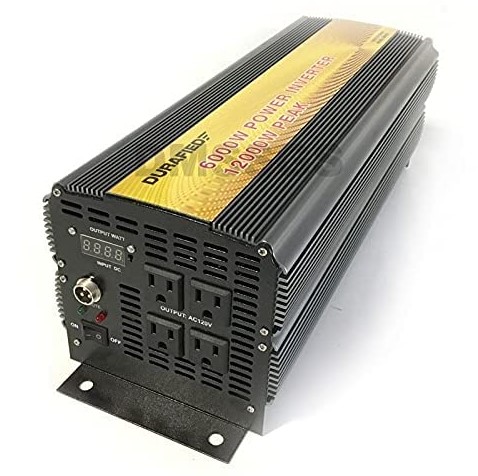
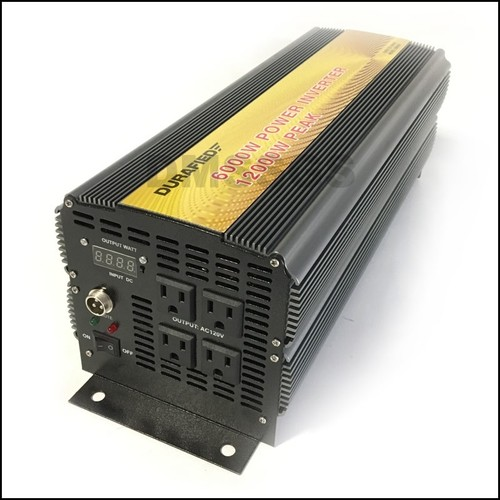
    To set up my system I purchased a 6000 watt modified sine wave inverter. I scored it in an ebay auction for $180, or a little less than half the normal price for this unit.

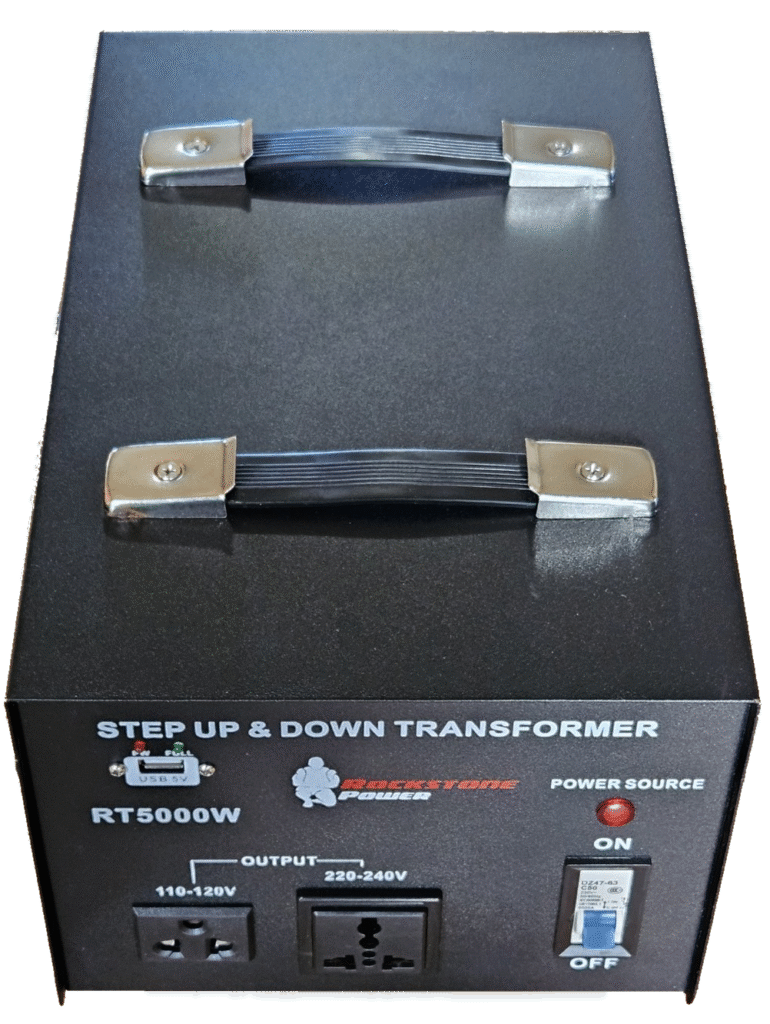
    Slight update, 4 years later – I moved to an area where I’m no longer on city water, and my well pump is 240V. In order to allow us to continue to use water during a power outage I also purchased a step up transformer.

    Can it run what I need?

    In my tests so far, I’ve been able to run the following equipment without issue:

    1. 1.6 HP Dewalt Air Compressor
    2. 15 Amp Dewalt Chop Saw
    3. 15 Amp Dewalt Table Saw.
    4. 240V 1HP Well Pump (using step up transformer)

    Many people who purchase inverters underestimate required wattage of the inverter that they need to purchase, the size of the battery bank needed to operate that inverter, and the size of the wire needed to provide the required current with minimal voltage drop. Ideal voltage drop should be zero, as any voltage drop would need to be compensated for by using a larger battery bank (since the total resistance of the battery and wiring would need to be considered when accounting for voltage drop at the load).

    Do I need additional Deep Cycle Batteries?

    A rule of thumb is that for every 1000watt-hours you intend to use from your battery bank before recharge, you’ll need two 100ah deep cycle batteries (or 6 regular car batteries). As an example: say I use a 100watt LED light for 4 hours, and a 1800watt table saw for 30 minutes. That’d be the limit for two average 12v deep cycle batteries without a recharge. I have no intention of purchasing a 12v deep cycle battery, as I am only using this system for emergency backup, and both price and storage space are at a premium for me.

    What is the cost for the entire setup?

    Here is a breakdown of my costs for this project including shipping and local tax:

    Item:Total Cost:
    Inverter (Ebay)$186.04
    5000W Voltage Converter Transformer (Ebay)$67.14
    Connectors (Amazon)$32.85
    Cable (Locally Acquired 00 Gauge)$27.68
    Cable Lugs (Ebay)$8.79
    Solder (On Hand)~$2
    Total Price$324.50

    A purchase price of of $320 would not buy you a generator that could provide anywhere near the instantaneous current flow that this inverter can. I’ll admit that there are additional fuel costs that running a car engine necessitates, but according to the data that I can find online, a car will only burn 0.25 to 0.5 gallons per hour, or less than $1.75 in fuel per hour of usage. This means that your average power outage lasting 6-8 hours would only cost $10 or so in fuel.

    If you are hoping to be prepared for a 7-10 day power outage, and can’t be bothered to shut down the car/inverter setup for part of the day (or night), then you should consider a generator. The cost of idling your vehicle for this long would begin to overcome the price advantage of the inverter.

    Another important consideration is reliability. Inverters can provide long term reliability, especially if they are run well below their peak current rating. A generator may require: oil changes, new spark plugs, draining fuel after each use or using stabil & ethanol free gas. It isn’t that I hate small engines, I just know that small engines are not a maintenance free option.

    Should I buy a Modified Sine Wave or Pure Sine Wave Inverter?

    This is a question with no simple answer. Since the cost of a 6000+ watt pure sine wave inverter was out of reach for me, and as this system is only for backup, I made the decision to cheap out. I’ve run a lot of items on inverters over time, and I have yet to discover a situation where a modified sine wave inverter wouldn’t get the job done. The main issue with modified sine wave inverters is heat dissipation: in a motor or power supply that is used continuously or for long periods, this heat can build up and cause issues. In my case, if I find something that doesn’t operate on my inverter, I’ll just not run that thing during the time that the inverter is providing my power.

    One thing that I discovered does not like running on modified sine wave power is my fan blower for my fireplace. I use a 1TDR7 fan, and it HOWLS when on the modified sine wave. It seemed to spin at roughly the same RPM, but man is it loud. To the point where my children who were sleeping about 6-10ft away couldn’t go to sleep with it until we surrounded the fan with pillows and blankets to deaden the noise somewhat. For those who want to get nerdy, this is because my fan is a Permanent Split Capacitor (PSC) induction motor, which uses a run capacitor to adjust the timing of the current flow within a winding placed 90 degrees apart from the main winding and provides for a smoothly rotating magnetic field for the rotor to be attracted to. (Do a youtube search for “Permanent Split Capacitor (PSC) induction motor” if you are curious and want more on that subject.

  • How to CRUSH Engineering School

    How to CRUSH Engineering School

    Printed Circuit Board Designed By An Electrical Engineer

    First of all, you have to be motivated to succeed. I don’t know how to help someone with that, so I’m going to skip it. Instead I’ll talk about what I do know…how to succeed once you are motivated.

    Time as an Investment

    Engineering school takes time. Lots of time. I’d estimate the average 3.0GPA and above student spent well over 40 hours a week on school. Some spent as many as 80. Go to school early in the morning, and don’t leave at night until all your homework is done. I don’t know how to say this, but electrical engineering can be dry subject matter. There are no engaging story lines in this field, aside from the ones that you write yourself. Occasionally professors will bring up how a discovery was made in engineering or science, but these are few and far between in an engineering program that on average takes 5 years to complete. You must constantly remind yourself why you are doing this, what it is you want out of the program, and how it will benefit you in the long run.

    Time Management

    Use a Calendar. Carry the calendar with you everywhere (I printed mine on 8.5×11 sheets of paper and put it in my assignment binder) as soon as you are assigned a project, put it in the calendar. Live and die by that calendar. If an assignment changes dates, make sure that you change the date in the calendar. Continually come back to that calendar, use it to motivate yourself (or others if you can’t do your homework without them).

    Be Good at Math

    If you didn’t crush Calculus 1 in highschool, don’t expect to be able to pick this up without remedial math, and a lot of hard work. Start working on your math skills right now (preferably before the semester starts). My own math background was lackluster, and I managed to get through the program via sheer willpower. It can be done without this prowess, but the engineering program will be much easier for you if you excel at math.

    Professors as a Resource

    Go and talk to your professors. This is so inconvenient, but there are times when it is very worthwhile. I would sometimes force myself to complete assignments a day or two early only so that I could go and talk to the professor before the item was due when I had a problem. Some professors are vastly more helpful then others are. You’ll discover in the first few weeks of a class which professor is helpful and which is not. I also discovered that many professors like (or at least don’t mind) if you come to them to talk over a test that you recently completed. It helps them see that you care about their class, especially when your grade on the exam was better than average.

    Friends as a Resource

    Make school friends: The more friends you have, the less likely you are to miss something important that will affect your grade. Especially make friends with at least one person who knows how to take good notes. Sometimes being able to look over the notes that someone else took can save you a lot of points on a homework or exam.

    Don’t be afraid to ask for help. This was a hard one for me personally because I always felt like it was cheating to ask for help. Like somehow I should be able to do this all on my own. Obviously there are cases where you can’t do this (take home tests for example) but when not specifically prohibited from doing so, I would often find someone who was doing better in the class then me, and bug them. This got far easier as I got further into the program and had built relationships with people who started the program around the same time as me.

    Chegg (or Slader)

    Don’t use Chegg. This might be a controversial take, and I think that there are strong opinions on both sides, but I don’t recommend Chegg. I feel like having this subscription was a barrier to learning for many of my fellow classmates. That being said, I highly recommend having a friend that you do homework who has Chegg. That way if there is one question that you are both stuck on, they can look it up for you and walk through the problem. Depending on how much busywork your school requires, having this subscription may be more or less detrimental to your learning.

    Top Resources for Completion of an Electrical Engineering Degree:

    Hyperphysics

    The best resource on the internet for engineer students is doubtless this website. Obviously geared toward physics, but helpful none the less.

    Crashcourse Physics

    Somehow they manage to make learning equations fun. The other CrashCourse courses are very good too, but physics is probably the best.

    Zahi Haddad

    This guy knows how to teach circuits and electronics. A friend of mine found him on Youtube, and he helped me immensely. You’ll spend 1/3 the time learning that you would with other lecturers, because he doesn’t ever allow you to get confused.

    OrganicChemistry Tutor

    His videos come up often using youtube search for STEM search terms. His videos are gold.

    MathtutorDVD “Math and Science”

    This guy knows what it takes to learn Math (and several other subjects) and can break the process down it to small steps that anyone (even the math challenged) can master. It would probably be worthwhile to order the DVD’s from him, but I never did.

    Michael Van Bizen

    Super strange and memorable dude. Reminds me of a rarely seen eccentric uncle. But sometimes his examples are so spot on that you really can’t beat him.

    Flipping Physics

    Useful during calculus based Physics 1 & 2

    Slader

    This website has answers to the “canned” textbook questions that are a waste of time. I must emphasize that you should never look at the answer to a question before you have spent a fair amount of time understanding what the textbook has to say about that subject, and thoroughly completed the problem (attempting to do your best to solve it). There are no shortcuts to learning.

    Post Graduation

    These are best for real world practical application, not theory, but they always reminded me why I chose EE in the first place:

    Electronics Tutorials

    RSD Academy

    All About Circuits

    Great Scott

    EEVBlog