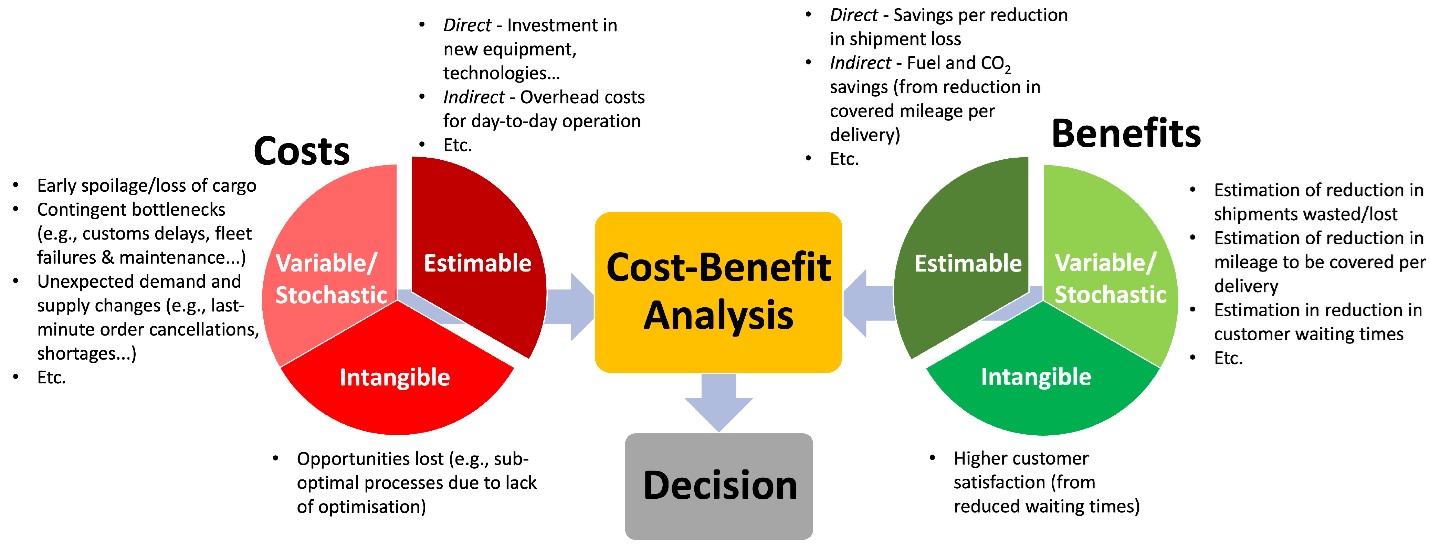
This analysis is most useful if your decision lends itself to quantification in dollars and cents. I did a cost benefit analysis during my first year in the engineering program to compare a career as an electrician to that of an Electrical Engineer. The time to payoff was longer than I had expected, about 12 years overall, but obviously 4 of those years I was earning reduced wages, and also paying for school.
I want to help you understand the diagram above, so let me give some definitions. If the chart already makes sense to you, skip the definitions.
Variable/stochastic: Definition of “stochastic”: randomly determined; having a random probability distribution or pattern that may be analyzed statistically but may not be predicted precisely.
Estimable: Capable of being estimated.
Intangible: Something that can’t be nailed down.
Why would I do a Cost-Benefit Analysis?
Determine the soundness of a decision.
Provide a basis for comparing alternative decisions.
What does the process look like? Where do I start?:
Brainstorm costs/benefits.
Assign a weight or dollar value to each cost and benefit.
Compare the overall costs to the overall benefits, (assess the alternatives)
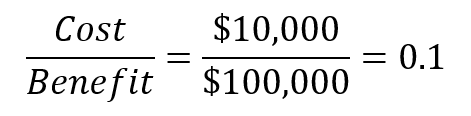
Cost-Benefit ratio: cost divided by benefit. The closer the ratio is to zero, the more likely you should implement that course of action.
An activity that would cost $10k, but only provide $10k worth of value would be a waste of time!An activity that would cost $10k but would provide 100k worth of value sounds like a sound investment.
Be careful when you are doing analysis of this type. You need to take into account the time value of money. The value of $1 now is not the same as the value of $1 when you are 60 years old. Both because you could invest that $1 in the interim between now and when you are 55, and because earning $1 will likely be significantly easier when you are 55 then it is now.
I’ve been analyzing how I spend my time for the last few days.
As I write these words, I’ve undertaken a project that is very large: I’m building my own house from scratch with no assistance from a construction crew, just me, with a few friends and my wife lending a helping hand from time to time.
If I wind back the clock 5 years, I was spending an immense amount of time on schoolwork in a degree program that I had interest in, electrical engineering.
Wind back the clock 5 years from that, and I was spending an immense amount of time on schoolwork that I had no interest in.
My point is, as I’ve gone from financially insecure to financially secure, I’ve also gradually moved from work and school relating to subjects that were of minimal interest to me, to ones that were exciting to me and that I’ve always had a basic curiosity about.
From that viewpoint I’ve basically moved myself from doing things that were fun and or satisfying, but I had no intrinsic interest in, to things that were fun, satisfying, and I was also interested in. It was merely happenstance that the career path that that I chose also happens to be incredibly challenging, it also rewards those who choose it with higher than average career earnings.
But honestly, we live in the United States of America, and there is so much cash floating around out there that basically any career path can experience a similar trajectory. Which brings me to the point of this post. Any pursuit that we choose as humans must satisfy an innate curiosity that we have (and some people are obviously more curious then others) and when it doesn’t, we will inevitably be dissatisfied with the way that we spend the vast majority of our time. The average person will probably struggle to locate more than 60-70 hours of “free time” per week. If 40 of that is spent at work, what are the chances that you can really satisfy that desire to pursue hobbies and interests in the remaining 25 hours? Perhaps you can, but I think your chances would be significantly better if your career would also provide at least some satiation to your interests.
Here is where people get lost; your career cannot be 100% pursuing your hobby. Every person I’ve ever discussed work/career/life with has always expressed a few things that they wish their job didn’t require them to do. I’ve even had the conversation with people who made their art into a career, (think pottery studio owner) and these people complain about the administrative tasks that are draining for them. You must analyze what your deepest curiosities are about, and then pursue a career that begins to help you satisfy those curiosities.
It is human nature to be dissatisfied with the career that you’ve chosen, but if it is assisting you in your pursuit of a hobby, it becomes a much easier choice to stay with a company or a career path.
Granted, I do have a certain advantage over many people because both myself and my wife know how to live within our means, and that has set me up to pursue school as an adult without crushing student loan debt. But this path is open to far more people then might initially consider it, since the beauty of student loans is that if you carefully choose a higher paying career that aligns with your interests you can use your earnings AFTER the degree program to pay for current expenses.
The moral of the post is that when you have the financial security to do so, making the move to a job that satisfies an innate curiosity of yours can be a very satisfying and engaging life choice, and will definitely increase your satisfaction with your career path.
If you are this far through my blog post, I already know something about you… you care more than the average person about what you end up doing with the majority of your time. Make your job have elements of your hobbies, and you will not dread the morning commute to work.
I hope this post gives you some food for thought. Here are a few steps to get you heading in the right direction:
Never give up, and don’t settle. If you are late in your career, or far into schooling for the wrong thing, and you aren’t sure you can make the switch, believe me, it is possible.
Don’t expect everything about your job to be perfect. Even if you are in a good job, there will likely always be things that will bug you.
No regrets. If you know you will get to the end of your life and regret what you are doing right now, stop doing that thing as quickly as possible. You are never as stuck as you think.
Write down the things that you research and the things that interest you the most. This is an exercise that you can do in one sitting, or sit on it for a few weeks and write down thoughts as they come to you. One of the ways that I discovered my life path was that I spent a ton of time researching Nikola Tesla (a famous electrical engineer) my senior year of high school. I also read a TON popular science magazines as a kid. My curiosity was captured and it (eventually) directed my career path.
So you are 17-25 and unsure what you want to do with your life…
I’ve been where you are. In fact, I didn’t know what I wanted to do with my life until I hit 25.
I’ve lived in the Eastern, Central, Pacific, Mountain, and Alaska time zones since leaving home. See my post on choosing a geographical location. I’ve also worked in 4 wildly disparate career categories. So I feel like I have a pretty decent grasp of what the United States has to offer for a young person like yourself.
Picking a career can be hard. Even deciding if you want to go to college can be difficult, let alone what to study or which school to pick. Read on for a few of the pointers that helped me in my own personal search for the perfect career:
Interests:
If you are fascinated by a subject, and you want to/are willing to study it in your free time, you might want to pursue a career in that thing, whatever it is. Think about what you spend time doing, and what you would like to spend more time doing if you could.
Talents and Skills:
If you have a talent that you’ve practiced hard to get good at, and you are the best person you (personally) know at that thing, you should probably consider how you can fit your ability in that area with your calling/vocation in life. It might not fit with any of the careers that you are aware of, but ask people that you respect if they know of ways to apply those skills in a career path.
Ability:
This is your raw potential. What you are capable of at your very best. You haven’t developed a skill yet but you know that you could. This is your maximum potential under the right circumstances. For example, not everyone can succeed at math. You may be one of those people. If that is the case, engineering is not for you, no matter how interested you are in it. Engineering Technology on the other hand, perhaps. Even if you are great at math, perhaps you lack people skills. You didn’t get the opportunity to develop them in the environment that you grew up in, but you are confident that they will come. Start to try things out to see if you can master them, the more things you try out, the more you know what you have the ability to succeed at.
Self Discipline:
Certain careers take significantly more self discipline. If this isn’t something you’ve cultivated yet, consider whether you think you’ll be able to, or whether you’ll need to downgrade your aspirations to fit your lack of self discipline. (Keep in mind that you can increase your self discipline, this happens for many people as they age. For example, I personally wouldn’t have been able to finish an engineering degree had I started it directly out of high school, or if I had, my grades would have been far far worse.
Finances:
Not everyone is in the position to move forward with a college degree because of their finances. Very few people can live for free (though school can be almost free if you are smart, see my post on going to college for $75 a week). If you haven’t developed the necessary nest egg for school, consider living cheaply and working your tail end off until you have what you need. Be careful though, many people lose sight of their dreams and settle into a life of tedium because they don’t see progress toward their goals here.
Your Support Network:
Going to school is a difficult undertaking for more than the person who chooses it. It can be hard for their family and friends as well. I chose to go back to school later in life. I was able to choose that because my wife was supportive and did what it took to keep me in school. If you are a single dad, or you are providing for an elderly parent, excelling at school is going to be a lot more difficult, and you may need to take easier classes, or less classes per semester to maintain your sanity throughout school.
Other Things To Consider:
The biggest thing I can emphasize when considering your career path is to think ahead. Right now your interest is theater? Great, but be aware that you will probably not be among the stars of the stage. The chances of you landing a solid acting career are slim, and even slimmer if you aren’t willing to slog through several years of rejections before you get there. The data is in, and it shows that only about 2% of actors make enough money to live on. For every Morgan Freeman there is, there are literally thousands of extras who never get beyond the occasional un-credited acting part. Temper your dreams with reality. Get input from people you respect (real input, not just asking them to encourage you in the direction you’ve already chosen to go). If you like Computer Science and Pottery equally well, choose pottery as a hobby and the other as a career.
Be aware that your preferences change over time, so even if you don’t mind being a starving artist now, there may come a time when it gets irksome.
Start to try things out to see if you have interest in them, the more things you try out, the more you know what you find interesting.
Kids are expensive. If you plan to have children, consider choosing a higher paying career, even if your job satisfaction is slightly lower.
Not everyone who tries to become a full time artist will succeed. I can’t tell you how many people I’ve run into over time that have an “soft” degree of some kind who went back for a second degree, or leveraged their experience to move into another more lucrative but less desirable field. So when you are thinking of what career to pursue, be aware that those with extremely high job satisfaction often have a higher attrition rate because more people want those jobs than there are jobs available.
Please don’t be like me. A significant portion of my thought process for where I went to college directly after high school was something like this: “I want to go someplace that sounds fun”. My brothers had gone to a small college in southern Wisconsin that sounded like something from a dream. Cool people to hang out with, inter-mural sports 6 nights a week, and a cush job nearby that made paying for it all easy (notice that even 18 year old me thought about the financial side of things). They said the academics weren’t too challenging, which was a huge plus for me. I loved hanging out with people, and the way my brothers described it, there was a lot of that happening there. That was it. I asked my brothers whether I would be able to pay for it based on what I had in my bank account, and they said that I’d be fine if I could get the job that they had done: driving school bus. That was my entire economic analysis of where to go to school. No other opportunities were seriously considered. No idea what I would do with the degree when I graduated. And no awareness that technical schools existed where I could go to school for free… More on that in my other post here.
Other Options Besides College:
Cross cultural experiences:
Peace Corps: This is honestly a giant boost for your resume. I don’t exactly know why this is, and it isn’t something that people advertise, but everyone I’ve ever talked to in hiring has immense respect for someone who devoted a year of their life to a greater cause.
Christian Mission Work: If your church supports anyone, contact them and see if they need any help, or know of someone who does. This would be for those who would like to combine their volunteer service with something that they value, their relationship with Jesus.
Experiences in the USA:
Bible School: This is the route I personally did after High school. A solid choice if you feel uncertain about what you believe and you’d like to gain clarity about the Bible.
Wilderness Mentoring Camps: I have several friends that either run these or have attended them. They seem to be a mixed lot, with some being good, and others being a miserable experience. You should definitely talk to someone that has graduated from the program before you embark on this one yourself.
Start Your Own business: You can literally start your own pressure washing or lawn care business for a couple thousand dollars. See here for some other business ideas.
Work in a Factory: This is not something you want to do long term. Don’t get me wrong, there are certain perks, but it certainly isn’t the type of career that anyone should pursue unless life circumstances have closed all other doors. The remuneration is terrible.
Work in the trades: I worked in the trades for about 3 years full time, and an additional 2 years part time. I loved it. But the chances of sustaining a life altering injury are very high in this career. Accidents happen. The pay is fine, and most of these career paths allow you to open your own business (if you have the desire) after you have about 10 years of experience. But be prepared to “pay your dues” no one is pleasant to you in this type of position until you have proven yourself. And even then, many of the individuals you work with are, how do I say this delicately, “rough” / “real pieces of work”. Also, many of the jobs that you work (especially early in your career) may not cover vacation days.
Other: There are a few of you, probably less than 1 in a 1000, who have the chutzpah to do your own thing. Start your own business, succeed on your own, get excellent at that skill, and make money doing it. Go for it. Do it. Don’t be afraid of failure. Be afraid of not trying. The best time to fail in life is when you are young. That is because you have so many opportunities to recover after your failure. Also, when you are young you don’t have a lot of the baggage that you acquire later in life. You only have a finite amount of time, and if some of it is being eaten up in a relationship with a spouse, with kids, with maintaining a home, etc, you won’t have the time to focus on making that thing succeed. Also, unless you wait until later in life, when you’ve already amassed a decent amount of money, it can be very difficult to pursue something as risky as going out on your own or starting your own business when you have a family to support.
Specific Actionable Steps:
The following website will change your life if you let it:
It gives the wages of all the different jobs, and also has a write up about the amount of schooling that each career takes. I HIGHLY recommend it during your career search process. There is also a section on that website about what each career is like. You should read every article you can on the subject of your interest.
Please also consider reading my article on whether college is a good choice for you or not. For those of you who’ve already decided to go to college, how should you decide where to go to school? There isn’t any way around it, it takes work. Sit down and make a list of every school that you’d be willing to attend. Get on their website and look up their yearly tuition price, add $1500 to that number for fees and books. Multiply that price times the number of years you will be at the school, and that is the cost of attendance. Make an excel spreadsheet that has each of these numbers next to the school name, and list any other factors that would bring the cost of attendance up or down (expensive rent/living with parents/etc). A website like US News can make this process a lot quicker. I’d highly recommend using that site or a similar one, even if you have to spend a few bucks for a subscription.
Key Takeaways:
Okay. Here it is. If you walk away from this post with anything, make it this. Everyone has different interests and talents, but most people are not exceptional at anything. That isn’t a bad thing. I’m not exceptional either. That means that I probably am not going to make a good living as an artist, surfer, or some other job where the job satisfaction is VERY high, but median pay is low. This is why I went school for engineering. It was the shortest degree program I could find where the median wage over your career was north of 6 figures. Even a mediocre engineer makes good money.
You have the ability to DO HARD THINGS! I can’t stress this enough. YOU CAN DO HARD THINGS! School will be hard. Especially if you chose a career that has high expected earnings once you are done. People don’t know what they are capable of until they choose to try.
Don’t be afraid of taking a leap and failing. You found out something that you couldn’t do (at least at this point in your life). Find something else. And don’t be afraid to come back and try again, but give yourself some time to mature and gain some skills before you try again.
Listen, if you want to slip the colleges an extra $10,000 a year for your college experience, I’m fine with that. I’ve come to peace with the fact that not everyone can do what I did. But a quality education is still available to people at an affordable price if they know where to look. Anyone can graduate from college debt free if they want to. And that means you… yes, you! If you want the story version with all the juicy details, keep reading. If you just want the strategy I used, skip to the section with the headings.
Here is how I went about getting not one, but two undergraduate degrees for what many people spend on their first year (or even first semester!) of undergrad, and how you can do the same. Some of these tricks I used from the very beginning, and some I learned several years in.
There are 5 schools in my college experience, I’ll start with the most recent first:
I attended a state school in Alaska. The average cost of attendance was $4400 a semester, which is far below average, even for a state school. On average I paid less than $2200 a semester. The difference was made up by scholarships. My overall cost could have been far less, but I didn’t decide to attend school my first year until after the deadline for scholarships had passed. In other words, 56% of what I spent at the University of Alaska was during my first 12 months there. Total cost for 4 years of full time school? $17,600
I averaged $1000 dollars a semester for 3/4 of this undergraduate degree. How? Part of it is luck; I received in-state tuition at one of the cheapest state schools in the USA. The other part of it was hard work. I spent time on local scholarships, and they drastically reduced my overall school cost. In fact, I treated scholarship applications as a type of part time work. During the time when most scholarships had their deadline, I worked non-stop on them. Probably averaging 5 hours per scholarship application. At this point I already had a bachelor’s degree in education and this worked to my advantage as I filled out scholarships. I spent far less time than some people on scholarships, and I turned out high quality (judging by my success rate) applications.
I went to two different schools where the tuition was free. Yes, free. They were Christian schools and their goal, aside from education, was to prevent their students from graduating with debt. That didn’t stop one of them from charging ~$1000 a semester in fees, but who am I to complain? This is probably of limited usefulness to most you, since not everyone wants to go to a Moody Bible Institute. But it was great for me, and I walked away at the end of 4 years with an accredited undergraduate degree in education (Counseling to be precise).
After starting at this school, I learned about another school that would accept my credits toward an accredited bachelor’s degree. That sounded like a miracle to me, since I had no idea that accrediting agencies existed just a few months earlier, and hadn’t thought to check my school before I began. So began my process of transferring credits from one school to another. I’ve now attended 5 different schools. I promise that I hated school when I left highschool. There was nothing that sounded more boring. Learning grows on you though.
The strategies that I employed:
FASFA (Free Application for Federal Student Aid)
If you haven’t applied for this, you are throwing away money. Every single person who goes to school needs to apply for the Fasfa. Try to apply about 9 months before your classes start. At one school I went to I received a “Pell grant” for 110% of my tuition costs. This covered my tuition and all of my books, and I had some spending money left over. I can’t emphasize how important this is, especially if your parents are low income (student aid awards consider the income of your parents, as well as your own, until you turn 24, when it becomes dependent on your income alone).
This is the website where you’ll need to go to fill out the forms:
If you can, find some people that you respect to rent with. This could go really well, or it could be really hard. Even under the best circumstances, I’ve never lived with a group of people without having some high stress moments, but it has always been worth it. You will get to know people very well when you live with them, so make sure they are worth your time before you move in with them. I lived on campus, or off campus in a house with others up until I moved in with my wife.
Part time work
I highly recommend part time work to most people, unless they are shooting for a 4.0 GPA or have some other good reason to not work. I highly recommend looking for a part time job during your freshman and sophomore years in school that will allow you to work on homework while on the clock. Once you are a junior or senior, you hopefully be able to find a position that will build skills for your career. During each of my 4 year degrees, I graduated with more money in the bank than I started with. In order to do this, I worked full time in the summers doing what I knew how to do, construction. Use whatever skillset you have to make money. If you have no skills you can always be a waiter, busboy, coffee shop barista, valet, janitor or window washer.
Loans
Some people seem to have an allergic reaction to loans. They break out in hives at just the mention of that dreaded word. Maybe you are this type of person, you wake up clutching the sheets and shouting “24% APR COMPOUNDED DAILY, NOOOOOO!! Please read this paragraph with great care, because I’m going to tell you a secret that can change your life. Debt is only bad when it decreases your overall financial well-being. To illustrate this, take home ownership. Historically speaking, home ownership can be a great investment. If real estate prices rise at a greater pace on average then the current going interest on a mortgage, you may make money by being in debt! I bring this example up first, because the debt averse person is usually willing to make an exception for a house, simply because most people can’t afford a house without taking on debt. College “CAN” be far more advantageous then any mortgage, even with deep debt. Consider this: with 4 years of school, I literally doubled my earning potential. I have pay stubs to prove it. Even if I had to go into debt to do school (which I didn’t), it would have been a brilliant strategy. Say for the sake of argument that I needed to take out loans to finish that degree. The average student loan at graduation is $25,921. That means I could have paid my loan back in the first year after graduation, and still had an extra $10,000 to spare, not to mention a lifetime of increased earning above that. Do you understand why I think some loans are an acceptable risk? The risk is actually quite low for academically competent individuals who carefully research their desired career path and understand how the specific degree program and school that they’ve chosen will affect their work life & post graduation finances. If that isn’t you, then you need to do the research. If you are the type of person who isn’t capable of doing that sort of research, then maybe college isn’t for you.
Textbooks
I have an overactive conscience that won’t allow me to use any digital content that I don’t personally own, which eliminated the common strategy of finding textbooks online. What I did do was buy a previous version of the textbook, and often literally paid $200 less than my classmates for the book. Then I’d borrow someone’s book and copy down the questions that the professor required for that week, using my own book for everything else. I’d estimate this can save you from $150 to $800 per year on the cost of books. Libraries sometimes carry class textbooks, but you’ll have to email the professor early in order to find out what book the class uses, and check it out early from the library to be sure you get a copy (there are other cheap people out there too).
Transportation
If you don’t have to have a car, don’t have a car. Insurance, gas, and maintenance can really add up, especially if you can’t do maintenance yourself.
Standardized Testing:
Incidentally, I have never taken the SAT or the ACT. I started my college career at a non-accredited school which didn’t require any standardized test before entrance, and after that I was always a transfer student. But I have done my fair share of other standardized testing. Mostly college placement exams and CLEP tests. I did 17 CLEP credits. If I had been able to do more for my degree programs, I would have. They were so much easier then taking a class. The average time that I studied for my CLEP tests was about 8-10 hours. Less than many final projects, even for easy classes. I never failed a CLEP test, so I probably could have studied less. The one exception to this was Chemistry. I studied Chemistry for hours and hours. I never took Chemistry in highschool, so it was some kind of miracle that I was able to pass a CLEP test that covered two semesters of college level chemistry and lab. I highly recommend CLEP testing as an advantageous way to knock out some credits for (virtually) free. I think the tests were $80 each, including the proctoring fee. College credits are on average about $500, which means you could be saving thousands of dollars by taking CLEP tests. If you have interest in getting a college degree using CLEP tests or similar strategies check out www.degreeforum.net.
Scholarships:
I already mentioned it above, but spend time on scholarships. I don’t know how to emphasize this any more strongly. There are scholarships for people with good grades, but there are sometimes even ones specifically for people with bad grades. I recommend spending the most time on regional or local scholarships, then state scholarships, then national scholarships, as I never received funding from any national scholarships, but plenty of help from the others. Call the school you are attending, speak to their financial aid, and ask about scholarships that you can sign up for. They will steer you in the right direction. It is even worth setting up an appointment with someone who would know about scholarships if possible. Do this long in advance of the start of the school semester. My school had a cutoff in February for most scholarship applications for the following fall.
Know How Hard Your Classes Will Be
I highly recommend looking up every professor that you take using this website:
It gives you some idea of how difficult the professor will be. This allows you to plan much better for what classes to take in any given semester before the semester starts. This is only useful if other people have put a fair amount of reviews up. If you have a friend who is a year or two ahead of you in the program they will likely have a much better idea of what courses & professors will be difficult or easy.
Technical Schools: “Tech School”
These are public colleges that focus on non-four year degrees. They are cheaper, and usually require lighter homework requirements per credit hour. I knew people who couldn’t pass the physics or chemistry classes at the 4 year college, and they reported significantly easier classes at the tech school. They can also be a good strategy if you want to go to college, but haven’t decided on a major yet.
American Opportunity Tax Credit
I’ll just include a link so you can look it up yourself, but America subsidizes virtually every American college student with this tax credit.
Transferring credits is hard. It is so time consuming to try to figure out what credits will apply where. You will likely spend HOURS trying to understand how your credits transfer from one school to another.Take the time. It is worth it. I remember spending literally days figuring out what credits would transfer to my next program in school.
Honestly the credit transfer system for schools is broken. At some point you will need to see an academic advisor to see if your credits will transfer in. Very few schools will analyze your transfer credits unless you are an admitted student. If you are transferring credits, apply to the school and see what they say. If you don’t get the transfer credits you need, you are might lose out on your application fee, but that is better than having to retake entire classes because the school wouldn’t accept your transfer credit.
Once I started school, each progressive school accepted transfer credits from the school before it. It is a bit of a hassle to transfer as they usually require you to provide all kinds of information about the course work from your prior school, but think about how much time (and money) you’ll save by not having to complete any additional coursework! Transferring credits is a great strategy and you shouldn’t be scared to do it!