I’ve been researching the idea of using a running car with attached inverter for power backup since around 2009. My curious mind has always wondered if this might be a way to harness reliable power without keeping and maintaining a generator. I personally hadn’t done it on a whole house scale until sometime during 2022.
One of my goals in life is to eliminate all gas powered internal combustion engines from my maintenance purview. If you like doing that kind of maintenance, then this article is not for you.
The first thing to know is that you won’t be able to run very much off of a setup like this. No air conditioners, nothing that is going to be pulling a significant current, unless it has a short duty cycle (running a hot-plate for 30 minutes to cook your supper should be fine). The reason for this is because car alternators on average output about 90-130 amps. That sounds like a lot of current, this isn’t a replacement for a whole house generator, let me explain why…
Car Alternator as a Power Source
First of all, a 130 amp alternator cannot supply 130 amps unless the engine RPMs are significantly above idle. Most people plan to idle their vehicle when using the inverter due to considerations such as noise, fuel consumption, etc. A reasonable expectation for available amperage production is about 1/2 this number. If we halve 130 amps we get 65 amps of power at 14.3 volts (this is because your alternator puts out a higher voltage then your 12v battery in order to charge it). This leads to a power output of 930 watts. Unfortunately, not all of that power is available due to losses during conversion from 12VDC to 120VAC. Low cost inverters like the one that I deployed for this project lose about 15% of their power due to these inefficiencies. So the greatest sustained load that an average car could maintain without going dead would be roughly 790 watts.
Car Battery as an additional Power Source
To figure out how long your battery could survive before going dead, consider that a common lead acid battery size is 600CCA. This is the size that my Honda Pilot has. The approximate watt hours can be obtained by multiplying this number by 0.7. This means that the battery can supply 420 watt hours. But consider that the battery shouldn’t be run below 80% of capacity in order to prevent permanent damage to the battery (in the form of reduced capacity). This means that you actually shouldn’t average more than 100 watts draw beyond what the alternator can produce in any given hour.
To sum up, if you were using a 1000 watt load for 30 minutes, you’d be well within reason. If you intend to run a 1000 watt load non-stop. You are out of luck! For reference, an average furnace fan motor would draw 400 watts while on. This means that for a person in a cold climate that has a natural gas furnace and water heater, power outages could become a very minimal inconvenience.
As a secondary example, my 2nd generation Prius has a built-in 100 amp DC/DC converter, which would be able to provide greater power than the average gas vehicle’s alternator, because at idle, the maximum output of the converter wouldn’t have to be derated. This would provide (at least) 100A*14V*0.8=1120 watts of non-stop load.
My Setup
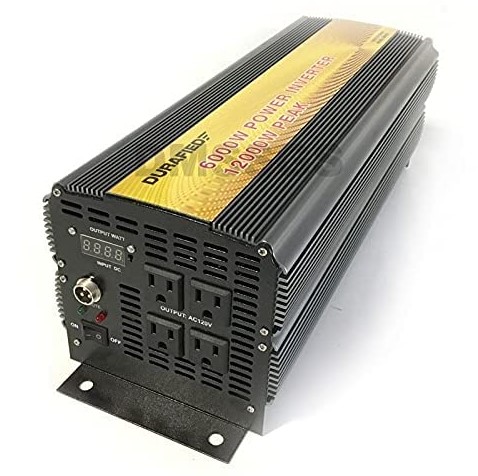
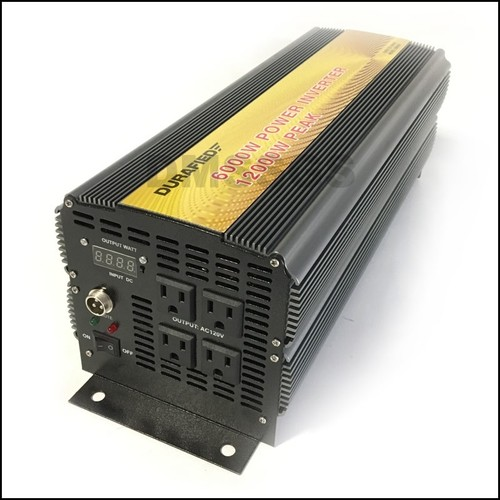
To set up my system I purchased a 6000 watt modified sine wave inverter. I scored it in an ebay auction for $180, or a little less than half the normal price for this unit.
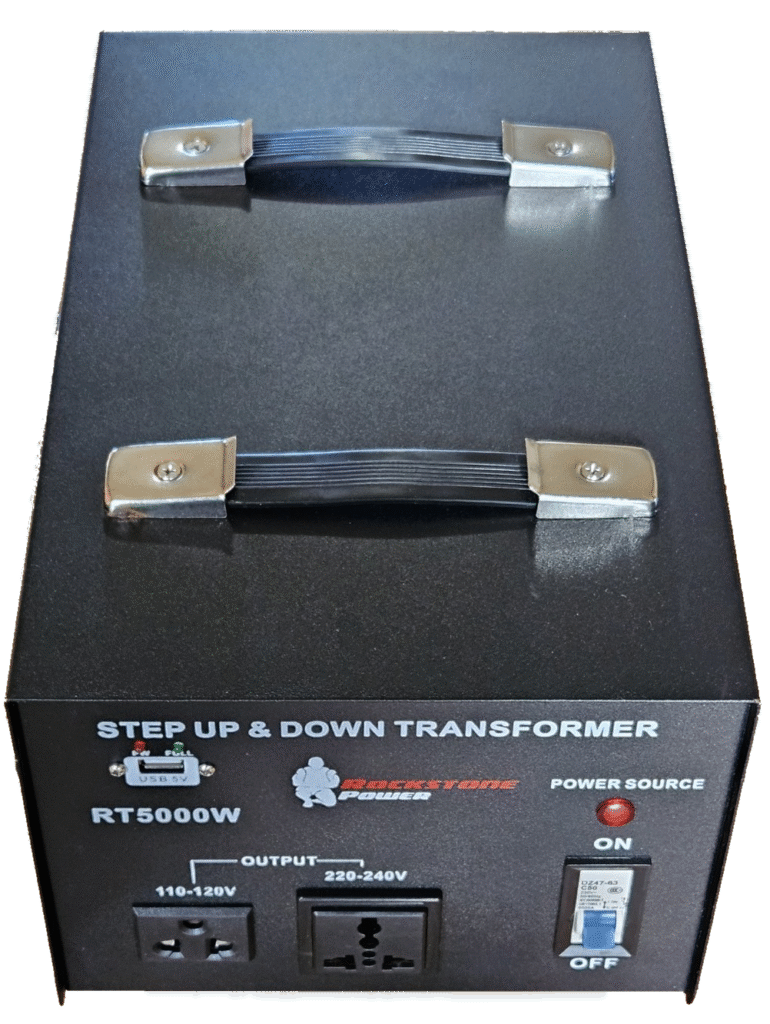
Slight update, 4 years later – I moved to an area where I’m no longer on city water, and my well pump is 240V. In order to allow us to continue to use water during a power outage I also purchased a step up transformer.
Can it run what I need?
In my tests so far, I’ve been able to run the following equipment without issue:
- 1.6 HP Dewalt Air Compressor
- 15 Amp Dewalt Chop Saw
- 15 Amp Dewalt Table Saw.
- 240V 1HP Well Pump (using step up transformer)
Many people who purchase inverters underestimate required wattage of the inverter that they need to purchase, the size of the battery bank needed to operate that inverter, and the size of the wire needed to provide the required current with minimal voltage drop. Ideal voltage drop should be zero, as any voltage drop would need to be compensated for by using a larger battery bank (since the total resistance of the battery and wiring would need to be considered when accounting for voltage drop at the load).
Do I need additional Deep Cycle Batteries?
A rule of thumb is that for every 1000watt-hours you intend to use from your battery bank before recharge, you’ll need two 100ah deep cycle batteries (or 6 regular car batteries). As an example: say I use a 100watt LED light for 4 hours, and a 1800watt table saw for 30 minutes. That’d be the limit for two average 12v deep cycle batteries without a recharge. I have no intention of purchasing a 12v deep cycle battery, as I am only using this system for emergency backup, and both price and storage space are at a premium for me.
What is the cost for the entire setup?
Here is a breakdown of my costs for this project including shipping and local tax:
| Item: | Total Cost: |
| Inverter (Ebay) | $186.04 |
| 5000W Voltage Converter Transformer (Ebay) | $67.14 |
| Connectors (Amazon) | $32.85 |
| Cable (Locally Acquired 00 Gauge) | $27.68 |
| Cable Lugs (Ebay) | $8.79 |
| Solder (On Hand) | ~$2 |
| Total Price | $324.50 |
A purchase price of of $320 would not buy you a generator that could provide anywhere near the instantaneous current flow that this inverter can. I’ll admit that there are additional fuel costs that running a car engine necessitates, but according to the data that I can find online, a car will only burn 0.25 to 0.5 gallons per hour, or less than $1.75 in fuel per hour of usage. This means that your average power outage lasting 6-8 hours would only cost $10 or so in fuel.
If you are hoping to be prepared for a 7-10 day power outage, and can’t be bothered to shut down the car/inverter setup for part of the day (or night), then you should consider a generator. The cost of idling your vehicle for this long would begin to overcome the price advantage of the inverter.
Another important consideration is reliability. Inverters can provide long term reliability, especially if they are run well below their peak current rating. A generator may require: oil changes, new spark plugs, draining fuel after each use or using stabil & ethanol free gas. It isn’t that I hate small engines, I just know that small engines are not a maintenance free option.
Should I buy a Modified Sine Wave or Pure Sine Wave Inverter?
This is a question with no simple answer. Since the cost of a 6000+ watt pure sine wave inverter was out of reach for me, and as this system is only for backup, I made the decision to cheap out. I’ve run a lot of items on inverters over time, and I have yet to discover a situation where a modified sine wave inverter wouldn’t get the job done. The main issue with modified sine wave inverters is heat dissipation: in a motor or power supply that is used continuously or for long periods, this heat can build up and cause issues. In my case, if I find something that doesn’t operate on my inverter, I’ll just not run that thing during the time that the inverter is providing my power.
One thing that I discovered does not like running on modified sine wave power is my fan blower for my fireplace. I use a 1TDR7 fan, and it HOWLS when on the modified sine wave. It seemed to spin at roughly the same RPM, but man is it loud. To the point where my children who were sleeping about 6-10ft away couldn’t go to sleep with it until we surrounded the fan with pillows and blankets to deaden the noise somewhat. For those who want to get nerdy, this is because my fan is a Permanent Split Capacitor (PSC) induction motor, which uses a run capacitor to adjust the timing of the current flow within a winding placed 90 degrees apart from the main winding and provides for a smoothly rotating magnetic field for the rotor to be attracted to. (Do a youtube search for “Permanent Split Capacitor (PSC) induction motor” if you are curious and want more on that subject.